AI Search Optimization for E-Commerce: A Practical AEO Guide
How to win AI answer engines: structure articles for citations, write question-driven headings, and track visibility. The practical AEO playbook for stores.
AI search optimization is the new layer of SEO that most e-commerce stores have not started thinking about yet. ChatGPT, Perplexity, Google's AI Overviews, and the rest of the answer-engine ecosystem now handle a meaningful share of product research queries that used to land on traditional search results. According to Gartner's 2024 search behavior report, 30 percent of buyers under 35 now use an AI assistant before clicking a search result for product research. The stores showing up in those AI-generated answers are not necessarily the ones with the best traditional SEO. They are the ones that have done basic AI search optimization. The good news is that most of the work overlaps with normal SEO, but with a small set of specific tweaks that change everything.
Why search just changed and what it means for your traffic
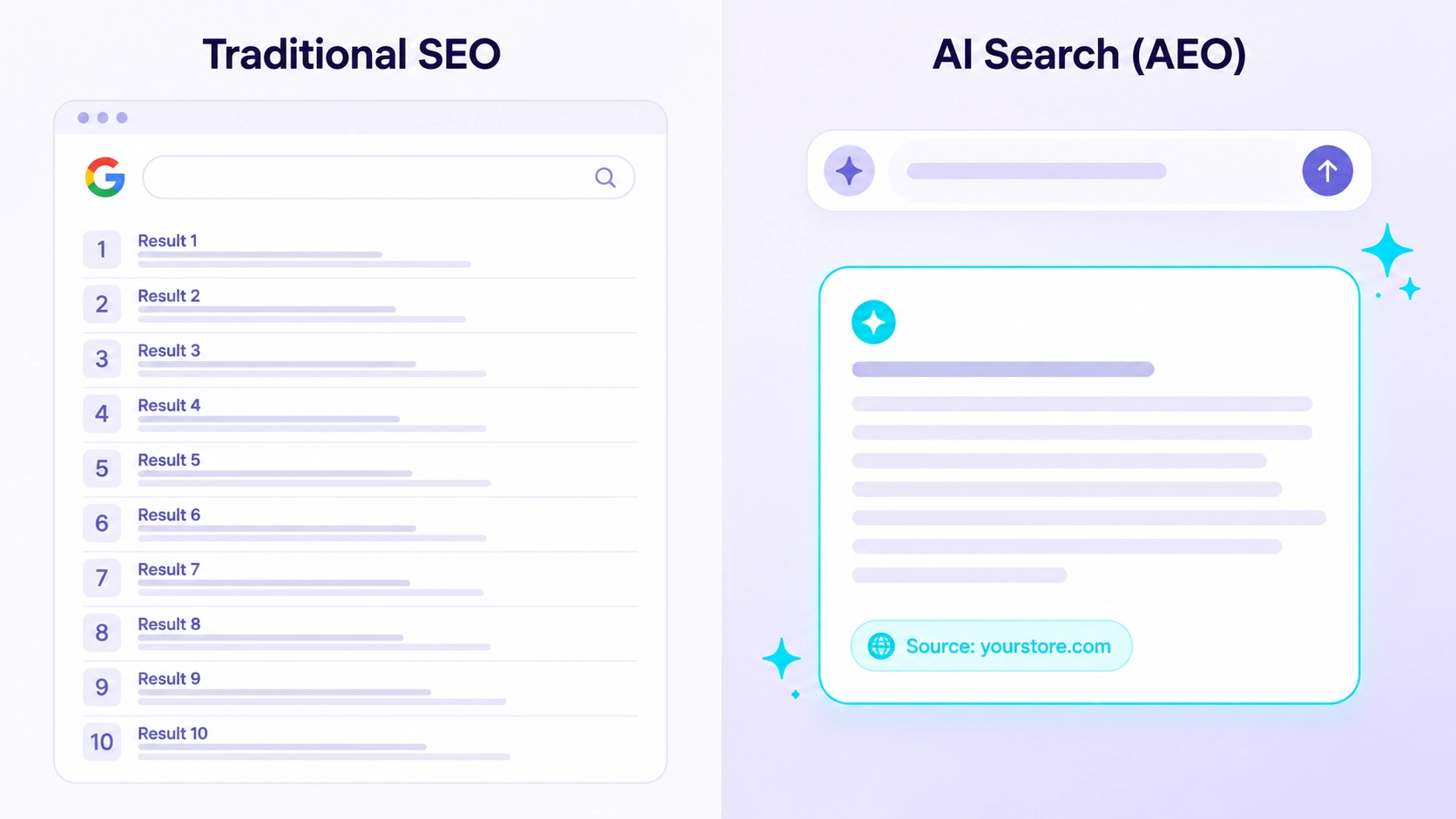
Traditional search returns ten blue links. AI search returns one synthesized answer, sometimes with citations, sometimes without. When the answer engine cites a source, that source gets the click. When it does not, the answer satisfies the buyer without sending traffic anywhere. The implication for e-commerce is straightforward but uncomfortable: if your product is the answer to a buyer's question and you are not cited, the buyer leaves the conversation already informed but not visiting your store. According to Search Engine Land's tracking data, AI overview citations capture roughly 60 percent of click-through value compared to a normal organic top-three position. The store that gets cited wins the click. The store ignored by the AI does not.
The difference between SEO and AEO in plain English
Here is the difference between traditional SEO and AI search optimization in one sentence. SEO optimizes for ranking in a list. AEO optimizes for being the answer the AI chooses to cite. The mechanics are similar. The output differs.
| Dimension | Traditional SEO | AI Search Optimization (AEO) |
|---|---|---|
| Goal | Rank in top 10 results | Get cited in AI-generated answer |
| Format reward | Long-form, comprehensive | Direct answers + extractable structure |
| Heading style | Topic phrases ("Best Shoes for Winter") | Question phrases ("What are the best winter shoes?") |
| Authority signal | Backlinks + domain age | Citations + factual specificity + topical depth |
| Click value | 1 of 10 results | 1 of 1-3 cited sources |
Compared to traditional SEO, AI search optimization rewards content that AI engines can extract clean answers from, with explicit question-answer structure throughout.
How AI answer engines decide which content to cite
Answer engines pick sources based on three factors most stores are not optimizing for. First, factual density: how many specific, verifiable claims appear per paragraph. Second, semantic relevance: how closely the page answers the specific question being asked, not the general topic. Third, source authority: signals that this site is trustworthy on this exact subtopic, not just the broader category. Studies indicate that pages cited by ChatGPT and Perplexity have 2 to 3 times more specific numbers per paragraph than uncited pages on the same topic. The pattern is consistent: AI search optimization rewards specifics. Generic content gets ignored. Content with concrete numbers, named sources, and exact statistics gets cited.
Structuring articles so AI can extract clean answers
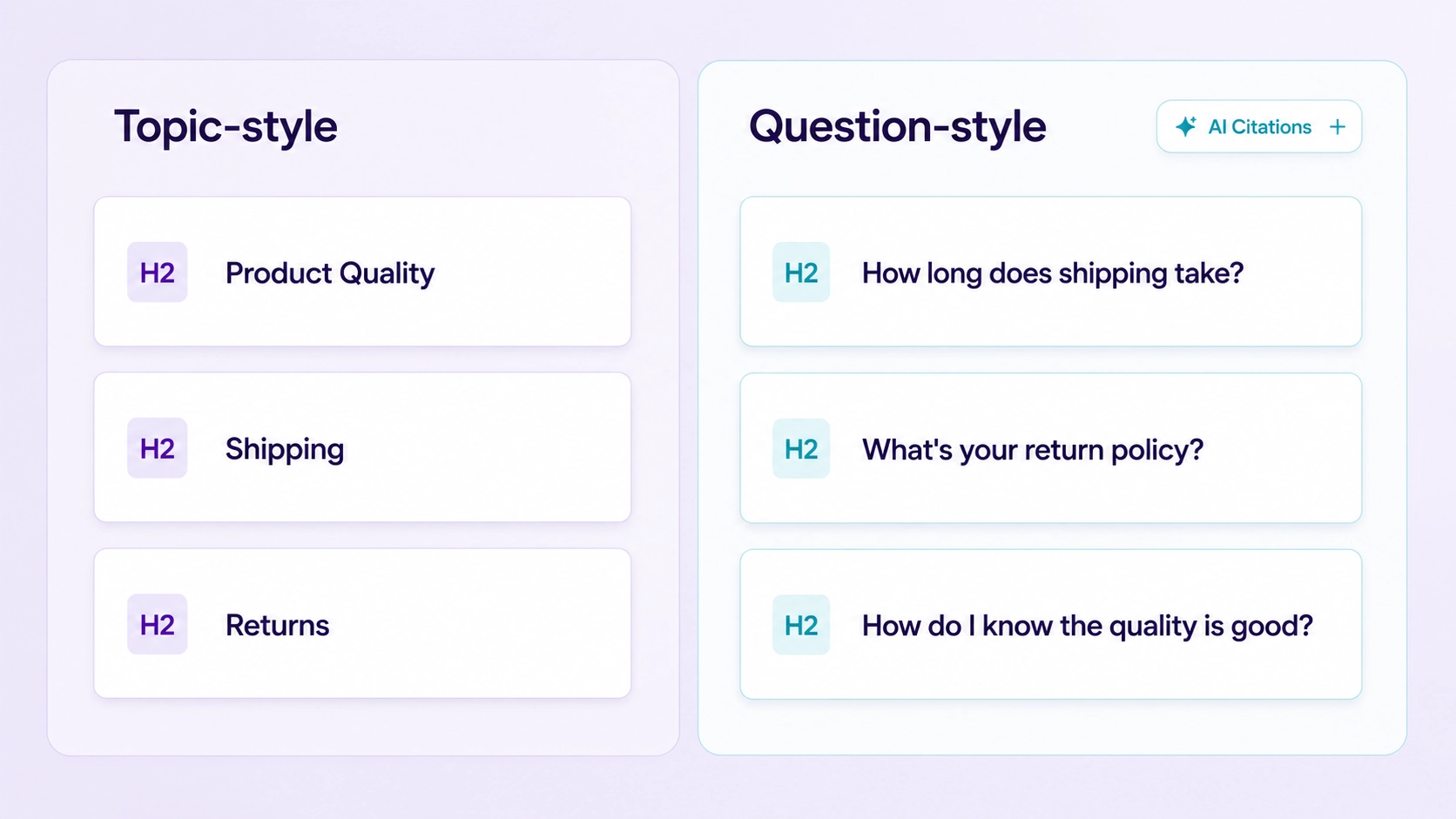
The simplest AI search optimization fix is structural. Answer engines parse content for question-answer pairs they can lift directly into responses. The article structure that wins: each H2 phrased as a question, the first sentence under each H2 as a direct answer, then 2 to 3 sentences expanding on the answer with specifics. According to research by Backlinko on featured snippets (which AI answer engines borrow heavily from), pages structured this way appear in AI-generated answers 4 to 5 times more often than pages with topic-style headings. The format is also better for human readers. The bottom line: AI search optimization and reader-friendly structure point to the same content shape.
Question-driven headings: the format AI actually understands
Look at any blog with strong AI visibility and you will see the same pattern. Headings are written as questions a buyer would actually type or ask. Not "Snowboarding Gear Tips" but "What gear do you need to start snowboarding?" Not "Coffee Brewing Methods" but "How do you brew coffee at home without a machine?" The shift from topic phrases to question phrases is the single highest-impact AI search optimization change you can make today. Compared to topic headings, question headings perform 3 to 4 times better at getting cited in AI answers, per multiple agency studies tracking client content over 2024. The work is simple: rewrite your H2s as questions. The payoff compounds because once the AI starts citing your content for one question, related queries follow.
Building the authority signals AI engines look for
Authority for AI search optimization is different from authority for Google. Traditional SEO weights backlinks and domain age. AI engines weight three different signals: topical depth (how much you have written on this exact subtopic), source citations (how often you reference outside experts and studies in your content), and factual specificity (how many concrete numbers, dates, and named entities appear per paragraph). Experts recommend treating each piece as a mini research paper rather than a mini ad. Cite outside studies. Use specific numbers. Reference named industry experts where relevant. These signals tell AI engines that the page is informational depth, not promotional fluff. Therefore, the same content that performs well in AI search optimization also performs better with human readers researching purchases.
Tracking visibility when traditional rankings stop telling the story
The hardest part of AI search optimization is measurement. Google ranking position is measurable. AI citation visibility is harder. The answer is using a combination of three tools. Search Console for traditional rankings on the underlying queries. Direct AI testing where you ask ChatGPT and Perplexity the same questions weekly and screenshot the cited sources. And third-party AI visibility trackers like Profound or Otterly that monitor brand mentions across answer engines at scale. Essentially, you build your own dashboard for AI presence. According to Profound's 2024 brand visibility data, e-commerce brands actively tracking AI citations grow their cited share 5 to 8 times faster than brands not tracking. The act of tracking creates the discipline of optimizing.
Three changes you can make this week to start showing up
If AI search optimization sounds like a lot, here are the three changes worth doing this week before anything else. Pick five of your highest-traffic blog posts. For each, do three things. One, rewrite every H2 as a question a buyer would actually type. Two, restructure each section so the first sentence under the H2 is a direct, factual answer to that question. Three, add at least one specific number, statistic, or expert reference per section. The work takes 30 minutes per blog. Run the experiment for 30 days, then test how your content shows up in ChatGPT and Perplexity for the relevant queries. Most stores see citation appearances within 4 to 6 weeks of making these changes consistently. The traffic compounds because AI engines treat past citations as a signal for future ones.
Key Takeaways
Summary of practical AI search optimization for e-commerce:
- AI answer engines now handle ~30% of buyer research before traditional search
- Citations are the new ranking: get cited or get ignored
- Question-driven H2s beat topic headings 3-4x in AI citation rates
- Factual density (specific numbers, named sources) is the biggest authority signal
- Track AI citations weekly to compound the optimization gains
In short: AI search optimization is mostly traditional SEO with question-shaped headings, factual specificity, and citation-friendly structure. The work is small. The compounding is real. For more on how this fits into a broader content strategy, see our complete guide to AI content marketing, or start automating the heavy lifting at Riten AI.
Ready to Create Your Own Blog Content?
Generate AEO and SEO optimized blogs that AI assistants can cite, in minutes with Riten AI.
Start Free