Content Creation for E-Commerce: The Complete AI Guide for 2026
How AI content marketing became the default for e-commerce stores under 50 employees. The four-step workflow, brand voice setup, and measurement framework that turn AI tools into actual rankings.
AI content marketing for e-commerce has gone from experimental to standard in the span of 18 months. The stores that adopted early have built content libraries 3 to 5 times larger than their competitors at a fraction of the cost. The stores that waited are now playing catch-up against rivals with hundreds of indexed pages. According to HubSpot's 2024 State of Marketing report, 64 percent of e-commerce brands now use AI tools as part of their content workflow, up from 23 percent just two years earlier. The question is no longer whether AI content marketing for e-commerce works. The question is how to use it well enough to compound results, instead of producing forgettable content at scale. This guide walks through the framework the highest-performing stores follow, the four-step workflow that turns AI tools into actual rankings, the briefing patterns that make AI output read like your store, and the metrics that tell you whether the work is paying off.

Why AI content marketing for e-commerce became the default in 2026
For most stores under 50 employees, AI content tools are now the only viable option for keeping up with content cadence. The math is straightforward. A traditional content marketing program costs $200 to $500 per article when you hire writers and edit thoroughly. To rank in competitive e-commerce categories, you need 50 to 200 articles in your topical cluster. That works out to $10,000 to $100,000 per category, which is more than most stores can afford. AI tools collapse the cost-per-article to under $20 and reduce production time from 8 hours to under 1. The result: the same content volume that used to require a team of writers can now ship from a solo founder working evenings. According to Content Marketing Institute's 2024 ecommerce research, stores using AI tools publish 4 to 7 times more content than those still doing manual production, and capture roughly 3 times the organic traffic over a 12-month window. The economics of content creation broke in favor of small e-commerce operators who learned the AI tools first.
What separates working AI content from generic AI slop
Most AI content fails not because the AI tool is bad but because the briefing was generic. The output reads like a Wikipedia article merged with marketing copy, full of vague claims and generic structure. The fix is treating AI tools as junior writers, not magic boxes. Working AI content marketing for e-commerce starts from a specific brief: the exact buyer query, the buyer's likely objection, the product context that resolves the objection, and the brand voice that signals trust. Compared to a generic "write a blog about X" prompt, a structured brief produces output that is 40 to 60 percent closer to publishable on the first draft. The other separator is product awareness. AI tools that connect to your catalog (Shopify products, descriptions, images, tags) generate content that references your actual inventory naturally, instead of generic product mentions a buyer immediately recognizes as filler. Studies show that product-aware AI content drives roughly 2.5 times higher click-through to product pages compared to generic AI blog content with manual product links bolted on after generation.
The four-step workflow that actually generates traffic
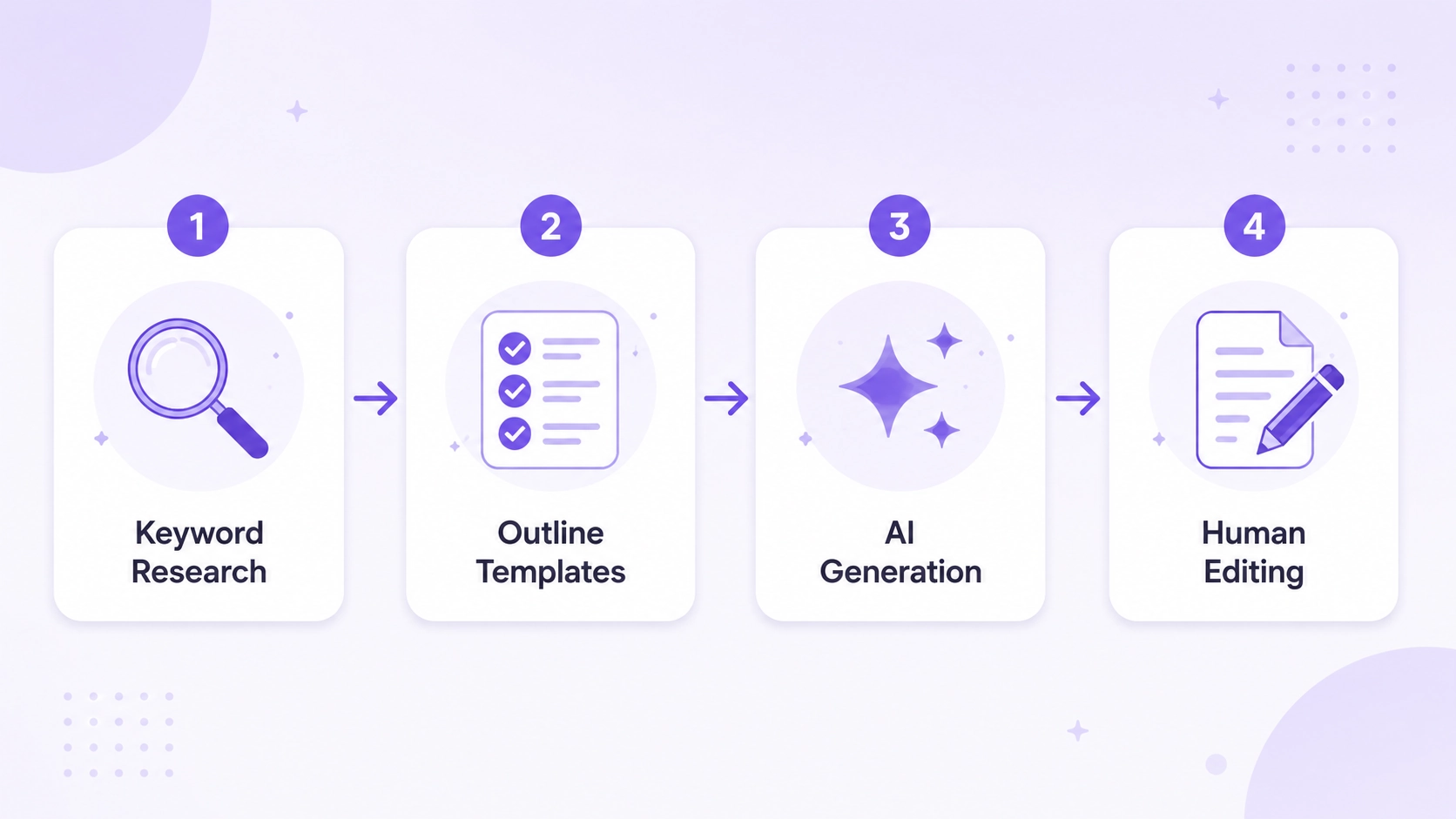
Working AI content marketing for e-commerce follows a four-step pattern that compounds across hundreds of articles. Step one: keyword research grounded in actual buyer behavior. Use Google Search Console for queries you already get impressions for, plus a tool like Ahrefs or Ubersuggest to find adjacent keywords. The goal is a list of 50 to 100 buyer-intent keywords ranked by search volume and difficulty. Step two: outline templates that match buyer search intent. How-to queries get how-to outlines. Comparison queries get comparison tables. Beginners' queries get progressive structure. Most AI tools let you pick the template; the smart move is matching template to query type, not picking what you find easiest to write. Step three: AI generation with full brief context. Brand voice, audience profile, product catalog, target keyword, and outline structure all passed in one coordinated prompt. Step four: human editing for the things AI cannot fix. Voice consistency across an article, factual claims that need verification, the exact opening sentence that separates a generic article from one that holds attention. The whole loop takes 5 to 15 minutes per article once the templates are set up. Therefore, the bottleneck is no longer writing speed; it is the discipline of running the same workflow consistently. The stores that turn this approach into a real channel are the ones that ship 2 to 5 articles per week through the same loop without skipping steps.
How to brief AI tools so the output reads like your store
Generic AI output is the result of generic prompting. The fix is teaching the AI three things before it writes a single sentence: who your customer is, how your store talks, and what your products do better than competitors. Most AI tools let you set a brand profile once and apply it across every blog. The fields that matter most: brand tone (Professional, Casual, Authoritative, Educational), brand voice (Informative, Conversational, Storytelling), customer persona (specific demographics, interests, pain points), and content goals (Educate, Drive Traffic, Generate Leads). Filled out thoughtfully, these inputs change the output dramatically. The same blog title generates a Wikipedia-style article without a profile and a customer-conversation-style article with one. Compared to default settings, custom brand profiles produce output that needs 30 to 50 percent less editing per article. The setup takes 5 minutes once. The compounding pays back across every blog you generate after that. Tools like Riten AI are built around this product-aware briefing model specifically for Shopify stores, with the brand voice setup detailed in our step-by-step Riten tutorial.
Common mistakes that waste your AI content investment
The pattern that repeats across stores struggling with AI content workflows: they treat the AI tool as a one-shot generator instead of a workflow, skip the brand voice setup, never measure which articles convert, and republish unedited AI output that reads like every other store's content. The biggest waste is publishing without editing the opening paragraph. The first 100 words of an article carry disproportionate SEO weight and reader attention. Generic AI openings tank both. Compared to articles with a hand-edited opening, fully unedited AI articles see 30 to 50 percent lower time-on-page and roughly 40 percent worse rankings six months in. The second biggest waste is not connecting the AI to your product catalog. Articles that mention products generically fail to drive product page traffic. Articles that reference real products with proper internal links drive measurable conversion lift. According to research from Search Engine Journal's 2024 ecommerce content study, AI articles with native product integration convert roughly 2.5 times better than AI articles with no product context. For a deeper look at the SEO mistakes specifically, see our guide to 10 e-commerce SEO mistakes.
How to measure whether your AI content is actually paying off
AI content marketing for e-commerce is easy to start and hard to evaluate. The trap is judging articles by traffic in week one, when the rankings have not stabilized yet. The right measurement window is 60 to 90 days post-publish. The key metrics are organic traffic to the article (Google Analytics 4), assisted product page traffic (cross-reference articles to product pages in GA4), keyword ranking improvements (Google Search Console), and bottom-line conversions tagged from blog landing pages. Stores running real measurement loops typically find that 20 percent of their AI articles drive 80 percent of the organic value. The lesson is to identify the winners early, double down on the topic clusters that work, and quietly retire the ones that do not. According to research from Orbit Media's 2024 content survey, blogs measuring AI content performance systematically grow organic traffic 2.7 times faster than blogs publishing without measurement. Track first. Then optimize.
Where to start with AI content marketing for e-commerce this week
Start with five articles, not fifty. Pick five buyer-intent keywords from your top performing categories. Set up a brand profile if you have not already. Generate using a structured template. Edit the opening paragraph and any factual claims. Publish. Measure at day 30, then day 60, then day 90. The pattern that emerges over the first 5 articles tells you everything you need about whether your setup is right. Adjust the brand profile if voice is drifting, adjust the keyword targeting if traffic is weak, and scale up cadence once the loop is producing results. Most stores find that within 90 days of running this loop consistently, AI content marketing for e-commerce stops being an experiment and starts being a real acquisition channel. For the AI search visibility side of this work (ChatGPT and Perplexity citations specifically), our practical AEO guide covers the question-driven structure that earns answer-engine citations.
Key Takeaways
Summary of practical AI content marketing for e-commerce in 2026:
- Cost-per-article dropped from $200-$500 to under $20; the economics shifted in favor of small operators
- Generic AI output fails; product-aware briefing with brand voice changes everything
- The four-step workflow: keyword research, outline templates, AI generation, human editing
- Brand profile setup takes 5 minutes once and saves 30-50 percent editing time per blog
- Measure at 60-90 days; expect 20 percent of articles to drive 80 percent of value
In short: AI content marketing for e-commerce is a workflow problem, not a tool problem. Set up the brief carefully, ship consistently, measure honestly. For a deeper tutorial on the platform side, see our getting started with Riten AI tutorial, or start at Riten AI for catalog-aware content generation built for Shopify stores.
Ready to Create Your Own Blog Content?
Generate AEO and SEO optimized blogs that AI assistants can cite, in minutes with Riten AI.
Start Free