How to Write Shopify Product Descriptions That Convert
The five-step framework for writing Shopify product descriptions that convert: lead with the buyer's use case, mine your reviews for customer language, and make proof part of the copy.
Writing Shopify product descriptions is the highest-leverage SEO and conversion task most store owners never get right. The pages get traffic. The traffic does not convert. The team blames the price, the photos, the audience targeting, anything except the words on the page that the buyer reads in the final 30 seconds before clicking "add to cart." According to BigCommerce's 2024 ecommerce conversion report, product page copy is the single biggest predictor of conversion rate variance across stores selling similar products. The good news is that writing Shopify product descriptions that convert is a learnable skill, not a creative gift. Here is the five-step framework that works.
Why your product descriptions are losing sales right now
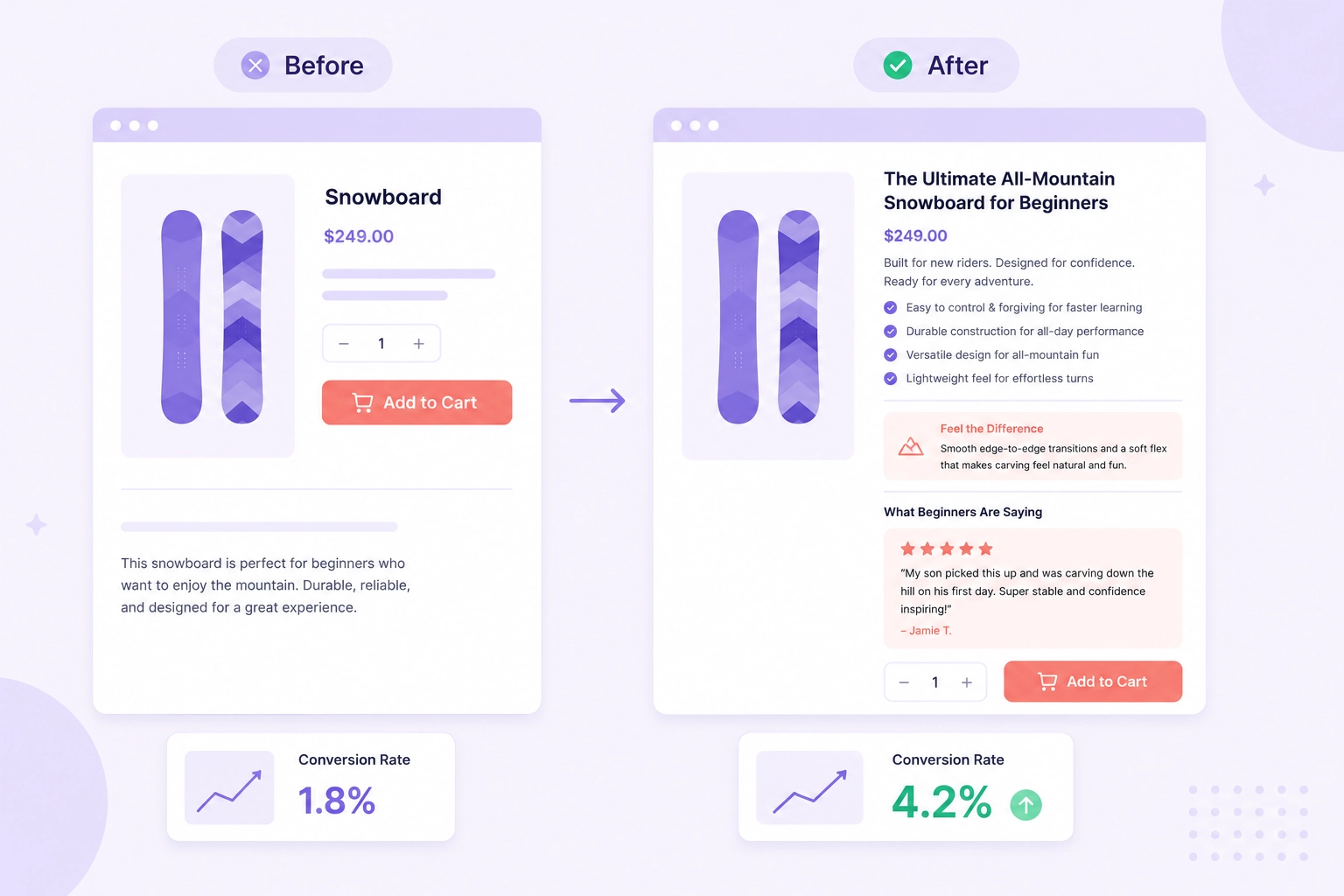
Most Shopify product descriptions read like a press release written by someone who has never used the product. They list features. They use brand-approved adjectives. They never address the real questions a buyer has at the moment they are deciding whether to spend $40 or $400. The result: visitors who already wanted to buy convert anyway, and the much larger group on the fence bounces. According to CXL Institute's 2023 product page benchmark, the average ecommerce product description is read by 78 percent of buyers but actually influences the decision in only 22 percent of cases. The gap is the real opportunity. Better Shopify product descriptions do not sell harder. They answer the specific questions a hesitant buyer has before they decide.
Step 1: Start with the buyer's actual question, not the product
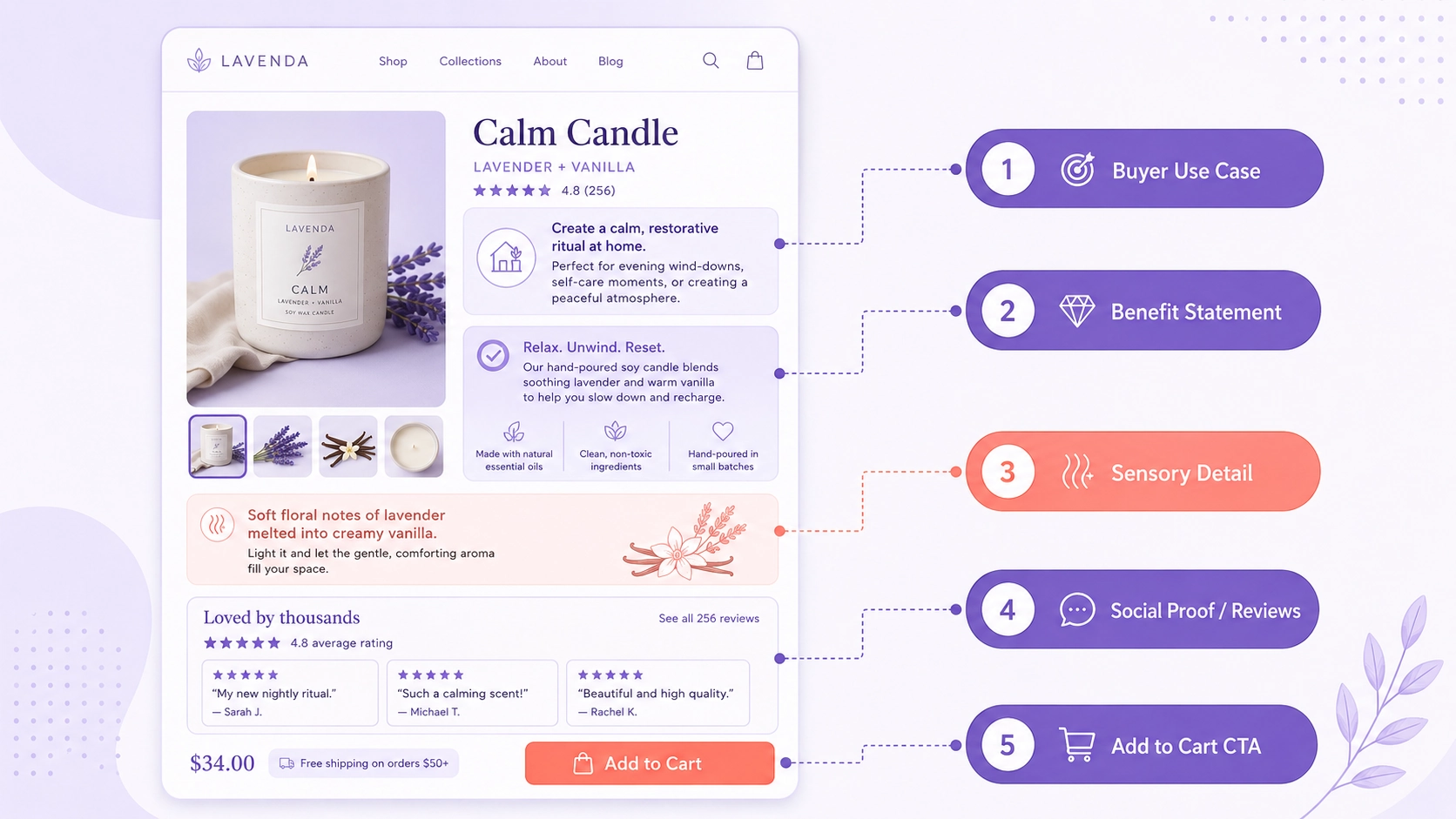
The first thing a buyer thinks when landing on a product page is rarely "what features does this have?" It is "is this the right thing for what I need?" Better Shopify product descriptions open with a sentence that addresses the specific use case the buyer was searching for. For a winter jacket: "Engineered for hikers in 20-degree weather who need waterproof shells without bulk." For a kitchen knife: "A chef's knife for home cooks who want restaurant-grade balance without the $200 price tag." Notice what is missing: brand bragging, generic praise, abstract benefits. What is present: who this is for and what specific problem it solves. Compared to a generic "premium quality" opener, the use-case opener moves a hesitant buyer 60 to 80 percent closer to checkout in CXL's eye-tracking research.
Step 2: Lead with the benefit before the spec sheet
Once you have the use case, the second sentence should be the strongest benefit. Not the most features. The single benefit the buyer cares most about. The classic mistake is putting specs first. The buyer wants to know what the product does for them before they care about how it does it. Studies show that benefit-led product copy converts 30 to 40 percent better than feature-led copy in head-to-head A/B tests. The structure: use case (sentence 1), main benefit (sentence 2), supporting detail with one or two specs (sentence 3), then proof. Specs still belong in the description. They just do not lead. Move them to a structured sub-section below the primary copy where buyers who want them can scan, and buyers who do not can ignore them without distraction.
Step 3: Write in your customer's language, not the catalog's
Your buyer's vocabulary almost never matches your product team's vocabulary. The product team calls it "moisture-wicking polyester." The buyer searches for "sweat-proof shirt." The product team writes "ergonomic cushioning." The buyer types "comfortable for standing all day." Better Shopify product descriptions use the customer's words for the first 40 to 60 percent of the copy, then bring in technical terminology where it adds credibility. The fastest way to find your customer's actual language: read your last 50 product reviews. The repeated phrases are gold. Whatever buyers say to each other in reviews is the same vocabulary they search for and respond to in copy. Audit your top product's reviews this week and rewrite the description using their exact phrasing. The key is matching how buyers think, not how your product team writes.
Step 4: Use sensory details that help shoppers picture the product
Online buyers cannot touch, smell, or test the product. The closest substitute is sensory language in the description. Texture, weight, sound, fit, smell. The more specific, the more believable. Compare these two openers for the same coffee bean: "Smooth and rich, with a balanced flavor profile." Versus: "Drinks like dark chocolate melting into orange peel, with the heft of a grown-up's morning." The first is generic. The second creates a picture in the reader's head. Sensory language is where Shopify product descriptions cross from product copy into something a buyer wants to read. Add one sensory detail per paragraph: the sound the lid makes when it closes, the feel of the fabric on bare skin, the visual texture of stitching. These details cost nothing to write and meaningfully change how buyers imagine using the product.
Step 5: Add the proof: reviews, numbers, specifics
The final section of every Shopify product description should include proof. Real numbers, real reviews, real specifics. "Loved by 4,800 customers" is proof. "Highly rated" is not. "4.8 stars based on 412 verified reviews" is proof. "Top-rated" is not. Where possible, embed real review excerpts directly in the description. The 30-word quote from a real customer about how the product solved their specific problem outperforms 200 words of marketing copy. According to research from Northwestern University's Spiegel Research Center, 95 percent of buyers read reviews before purchase, and product pages with embedded review quotes convert 27 percent better than those that link to a separate reviews tab. Make the proof part of the description, not an afterthought.
Test, refine, and repeat your way to higher conversions
Writing Shopify product descriptions that convert is iterative work, not a one-time exercise. Pick your top 10 products by traffic. Apply the five-step framework to each. Wait 30 days. Look at conversion rate change in your Shopify Analytics. Double down on what worked, rewrite what did not, and move to the next 10 products. Stores that systematically optimize their top 50 products this way typically see 15 to 25 percent conversion lift across the catalog within a quarter. The first version of a rewritten description does not have to be perfect. It just has to be better than what was there before. If you have hundreds of products and rewriting them by hand sounds impossible, that is exactly where AI tools earn their keep. Describing the same product 500 times is the kind of pattern-heavy work AI does well, and where Riten AI connects to your Shopify catalog directly to handle the work at scale.
Key Takeaways
Summary of the five-step framework for Shopify product descriptions that convert:
- Start with the buyer's use case, not the product feature
- Lead with the benefit before listing specs
- Write in customer language, mined from your reviews
- Add sensory details that paint a picture
- Include real proof: numbers, reviews, specifics
In short: better Shopify product descriptions answer questions buyers actually have. Apply the framework to your top 10 products this week, measure the change at day 30, and iterate. For more on writing AI-driven content at scale, see our complete guide to AI content marketing.
Ready to Create Your Own Blog Content?
Generate AEO and SEO optimized blogs that AI assistants can cite, in minutes with Riten AI.
Start Free