SEO Content Strategy for Online Stores: A Calendar That Works
Build an SEO content calendar that compounds: seasonal planning, 70/30 product-vs-brand mix, and a sustainable cadence you can keep for 12 months.
SEO content strategy for online stores fails in a predictable pattern. Stores publish furiously for two months, run out of ideas, fall silent for three months, and then post one rushed article when traffic drops. Repeat. The fix is not more discipline. The fix is a content calendar that matches how your store actually operates: seasonal cycles, product launches, and the specific search trends your buyers follow. According to Content Marketing Institute's 2024 ecommerce report, stores publishing on a consistent monthly cadence outperform sporadic publishers by 3.5x in organic traffic over 12 months. SEO content strategy for online stores is mostly a calendar problem masquerading as a content problem.
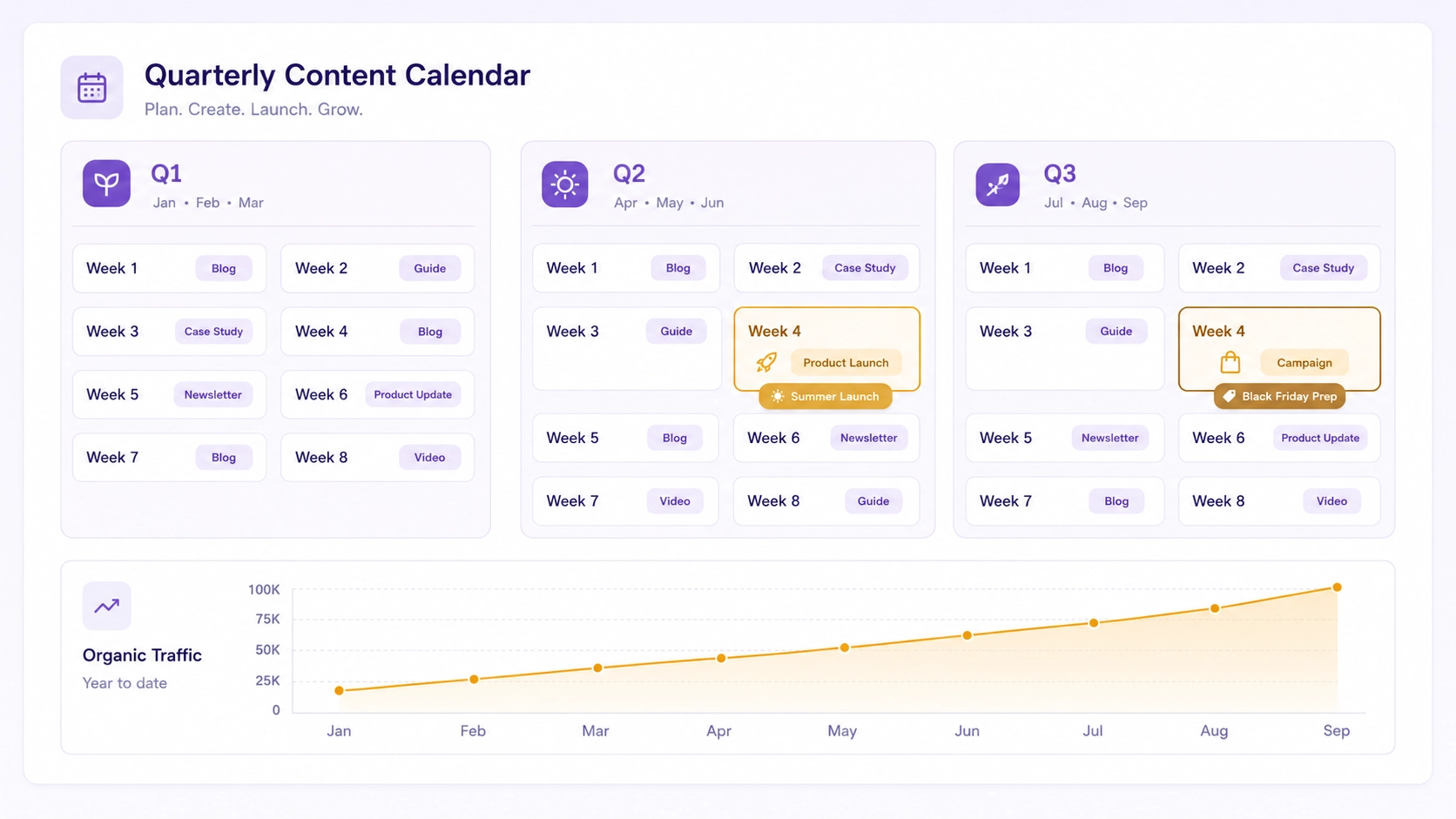
Why most Shopify stores publish randomly and pay for it in traffic
The classic mistake is treating content as a side project. The team writes when there is time, which is rarely. Topics get picked based on what feels relevant in the moment, which is usually whatever competitor blog they read that week. The result is a publishing pattern that looks like noise: 4 posts in March, none in April, 2 in May, and an article about Black Friday in late November. Search engines reward consistency. Random publishing tells Google you are not a serious source, and the rankings reflect that. Compared to a store publishing one article per week consistently, a sporadic publisher loses roughly 40 to 60 percent of their compound traffic potential over 12 months. The answer is not writing more. It is writing on a predictable rhythm tied to your store's actual calendar.
Plan around your store's seasons, not generic SEO calendars
Most SEO content calendars you find online assume an evergreen content schedule. That is wrong for stores. Your buyers shop seasonally even when the product is not technically seasonal. Coffee sales spike in January (resolution buyers) and December (gifts). Outdoor gear peaks in March (planning) and June (season). Furniture peaks at moves (May to September). Studies show that ecommerce search demand for any given category swings 40 to 80 percent between peak and trough months. Your SEO content strategy for online stores should publish ahead of those peaks: buying guides 6 weeks before the demand peak, comparison content 3 weeks before, and sale-driven content during the peak itself. Map your top 5 categories to their seasonal demand curves using Google Trends, then stack content in the 6-week window before each peak.
Mix product-traffic posts with brand-building stories
A balanced SEO content strategy for online stores includes two types of posts. Product-traffic posts target buyer-intent keywords that drive direct sales: "best running shoes for flat feet," "comparing X versus Y." Brand-building posts target awareness queries that compound into trust over time: founder stories, behind-the-scenes content, customer spotlights. Most stores publish only the first type and wonder why their content does not feel like a brand. Or only the second type and wonder why none of their posts drive sales. The key is roughly a 70/30 split: 70 percent product-traffic posts (the workhorse) and 30 percent brand-building (the long game). Compared to all-product or all-brand calendars, the mixed approach delivers stronger 12-month traffic growth while building a content library that also supports email, social, and product pages.
Build a cadence you can actually sustain past week three
The biggest reason content calendars fail is overcommitment in week one. The owner sets a goal of 4 articles per week, sustains it for 14 days, then quietly stops. The right cadence is the one you can keep for 12 months without burnout. For most stores under 5 employees, that means 1 article per week or 4 to 5 per month. Therefore, the SEO content strategy for online stores you actually execute beats the perfect strategy you abandon. Set the cadence based on your real capacity. Build a 3-month content backlog before launching to absorb bad weeks. Use AI tools where they save time without compromising quality. According to research from Orbit Media's 2024 content survey, blogs publishing weekly for 12+ months are 2.7 times more likely to report SEO traffic as a primary acquisition channel.
Key Takeaways
Summary of practical SEO content strategy for online stores:
- Random publishing tanks rankings: consistency beats volume
- Plan content 6 weeks ahead of seasonal demand peaks
- Mix 70 percent product-traffic posts and 30 percent brand-building stories
- Pick a cadence you can sustain for 12 months, not 12 days
In short: SEO content strategy for online stores is mostly a calendar discipline problem. Build a 3-month backlog, ship one post a week, and measure traffic compound at the 90-day mark. For more on the writing side of the workflow, see our complete guide to AI content marketing or start with Riten AI for the catalog-aware content generation that makes weekly cadence realistic.
Ready to Create Your Own Blog Content?
Generate AEO and SEO optimized blogs that AI assistants can cite, in minutes with Riten AI.
Start Free